
Chapter 12
What do you think about when you're hiking?

For the last decade, I've arranged my life around a passion for travelling long distances on foot. It started as a 24 year old, when I decided to walk coast-to-coast across India, a 2000km journey that I completed in early 2015. To this day, it remains one of the most difficult things I've ever done. The terrain, in theory, wasn't very challenging, as my route from Mumbai to Puri largely took me across the vast plains of the Deccan Plateau. It certainly wasn't mountain hiking. But the journey was testing in other ways: the heat, the solitude, the monotony of dirt roads and tiny villages, and the myriad of other small obstacles that I encountered on the way.
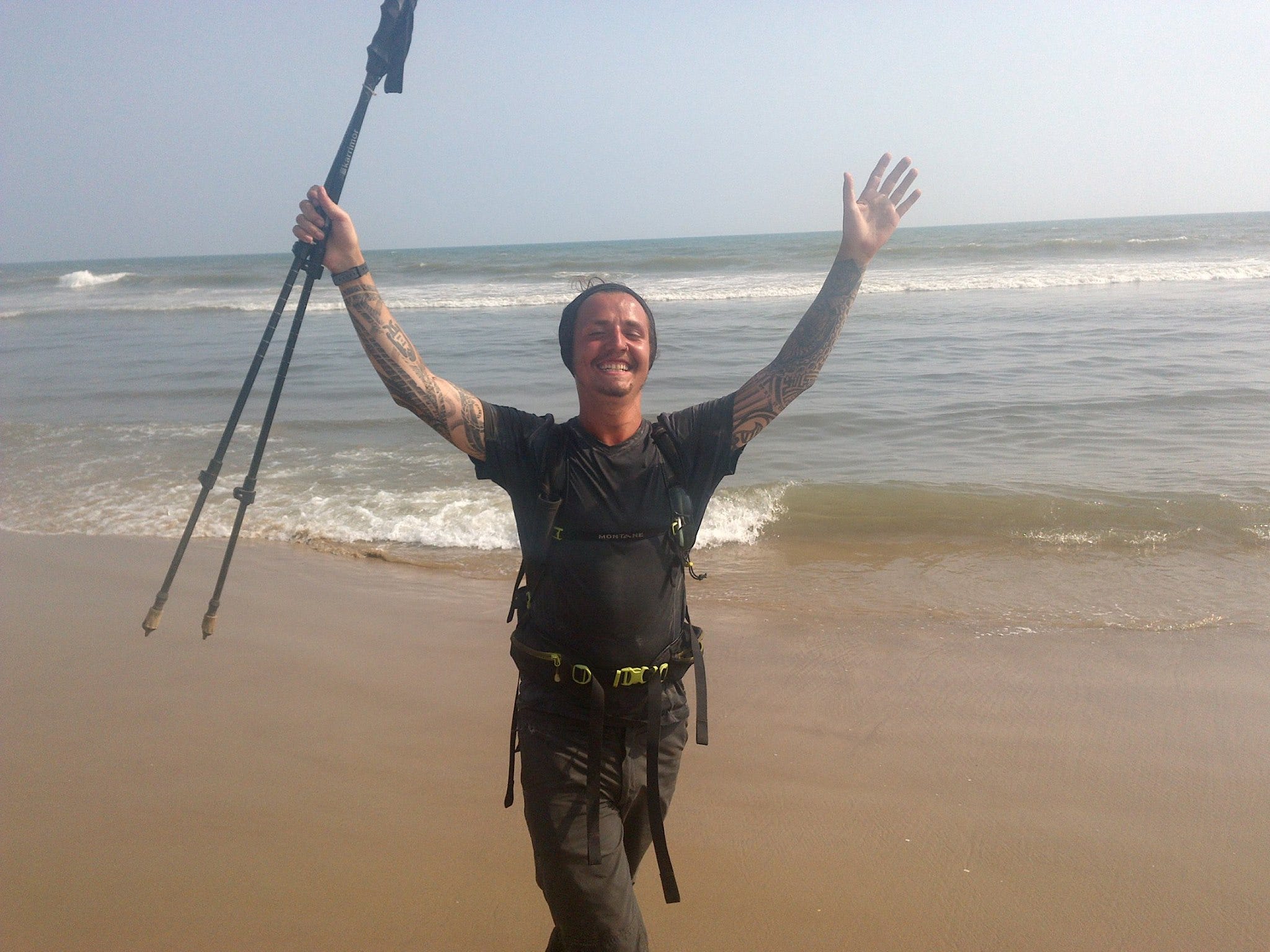
The walk took 51 days to complete, and in the intervening years when I've spoken to people about it, after the usual questions are out of the way (What did you eat? Where did you sleep? Did you get sick?), the most common thing people ask is 'What do you think about when you're hiking?'. It's a question I've always struggled to answer, because it's normally loaded with an assumption that so much time alone would provoke some profound revelation or other, or serve a therapeutic purpose. Sometimes it's followed up with a question about if I consider walking to be a form of meditation, which again, is something I struggle to answer, at least in any clear way. I'd normally say something vague like 'maybe', or 'sometimes'. It wasn't until I spoke with someone who was a serious meditator, that they provided a useful analogy.
This person had completed several meditation retreats, which sound much more gruelling than any hike I've completed. They're typically 10 days long, and involve 8-10 hours a day of seated, silent meditation. Outside of these hours, all communication between the participants is prohibited, as well as the use of phones, pen and paper, or any other means of distraction. She told me that while it may look to the outside observer that all those hours are spent meditating (people are sat on the ground, cross-legged, with their eyes closed, etc.), they're only really meditating for a small fraction of that time, until that is they become skilled practitioners, which takes many years of practice.
Her teacher once explained that there are three 'zones': red, orange and green. In the red zone, you're not meditating at all, and the mind is just racing along at its usual pace, with its usual pattern of fleeting and trivial thoughts about whatever happens to be preoccupying it at that moment. The orange zone is the beginning of at least attempting to meditate, where thoughts still arise, but the meditator tries to observe them impartially, watching them come and go with a sense of equanimity. This is normally aided by a focus on the breath. The green zone is actual meditation, a rare and difficult state to achieve, where the meditator reaches a state of being completely present, aware of the sensations in the body, but having the mastery not to react to them.
Hiking, I suppose, is similar. The vast majority of time is spent firmly in the red and orange zones, but sometimes, for a blissful and improbable few minutes, you'll be in the green. In the literature, this is normally referred to as the 'flow state', an elusive and mysterious condition where one is completely absorbed in the task at hand. I've experienced it occasionally, and when running, the physical exertion seems to disappear, as if you're floating down the trail. The runner Anton Krupicka describes it as 'an episode of greatly heightened focus, coordination and fatigue resistance'. Climbers, skiers and surfers talk about the same thing, often in moments that require their total concentration, normally at the risk of injury or death.
Loyal readers of the blog will know that my last hike in Ladakh was spent stubbornly lodged in the red zone, my mind struggling to be present whatsoever, let alone reach a transcendent state (except maybe when faced with the aforementioned risk of injury or death as we crossed the Hagshu La). Well, my ambition for Nepal was different. I wanted to be present, I didn't want to suffer. Fuck it, maybe I actually wanted to enjoy myself? It's a good thing that hiking here provides ample opportunity for such an experience.
Hiking in Nepal is a completely different proposition to hiking in India, mainly because of the presence of teahouses. A teahouse is a basic lodge that you can find dotted throughout Nepal's mountains, especially on the well established hiking routes. They provide a warm meal and a bed for hikers, which means you don't have to carry a full sleep system or very much food. You can therefore travel much lighter than in the Indian mountains, and they generally makes the logistics of hiking in Nepal pretty damn easy. This increased infrastructure does however come with an (unwelcome, in my view) level of regulation. Earlier this year, the Nepalese parliament passed a law that officially banned solo hiking, and demanded that every foreign hiker hire a certified guide. As you probably know from reading this blog, the idea of hiking with a guide is anathema to me, but thankfully three of Nepal's National Parks/Conservation Areas (Langtang, Sagarmatha and Annapurna) refused to enforce the new law, as they still want the business provided by independent hikers. It made my plan quite simple: I would go to each of them in turn.
Being only a half day's jeep ride from Kathmandu, Langtang was the obvious first stop. It's a simple route, with most people just doing an out-and-back down the valley from a place called Syabrubesi, stopping at the last settlement of Kyanjin Gompa to do a couple of day hikes to some local peaks. I decided I'd add to the route by hiking back to Kathmandu via Gosaikunda, a series of high altitude lakes considered sacred to Hindus, and then back through the foothills to the edge of city, where I could ride a local bus into town.
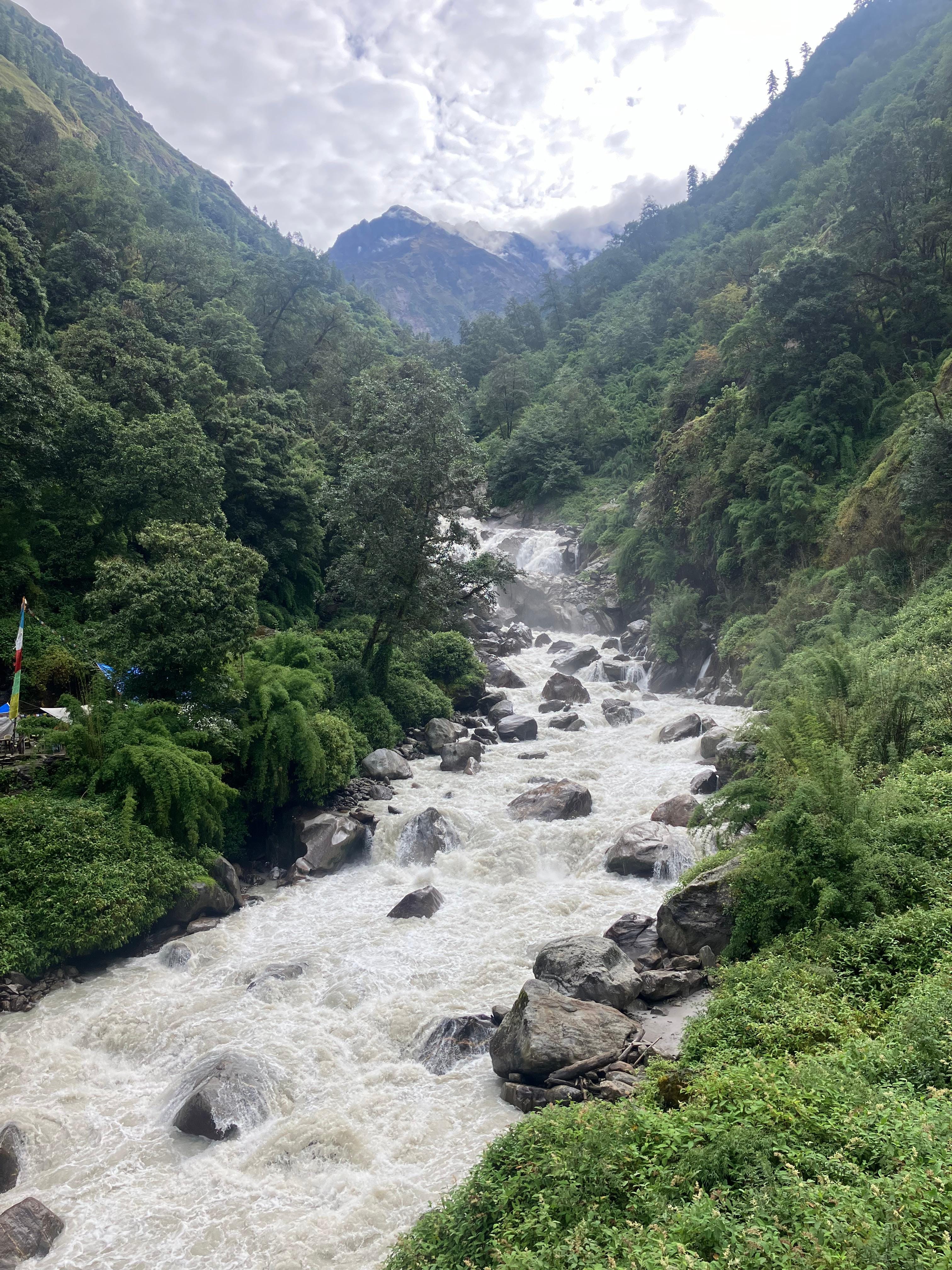
The first couple of days passed uneventfully enough, with just a slow, pleasant climb up through the lush forests of the lower valley. I stopped frequently at teahouses, chatted with other hikers, and generally savoured the luxury of having fresh legs and a light pack. The weather was getting increasingly moody, and on the third morning as I was hiking into Kyajin Gompa, the storm hit. It rained solidly for two days, and I had no option but to stay put and wait it out, as the teahouse owner relayed news of landslides lower in the valley sweeping away sections of the trail and footbridges over the streams.
The Langtang Valley is no stranger to extreme weather. In the devastating earthquake of 2015, a landslide completely buried Langtang Village, killing over 300 people and destroying all but one building. The village has now been rebuilt a few hundred meters away, and the hiking trail winds across the debris, the tragedy still fresh in the collective memory of the valley. While we sat playing cards in Kyanjin Gompa listening to the rain hammering on the roof, flooding was wreaking havoc on the rest of the country, particularly the Kathmandu Valley, where scores of people were killed as the city received its heaviest rains in over two decades.
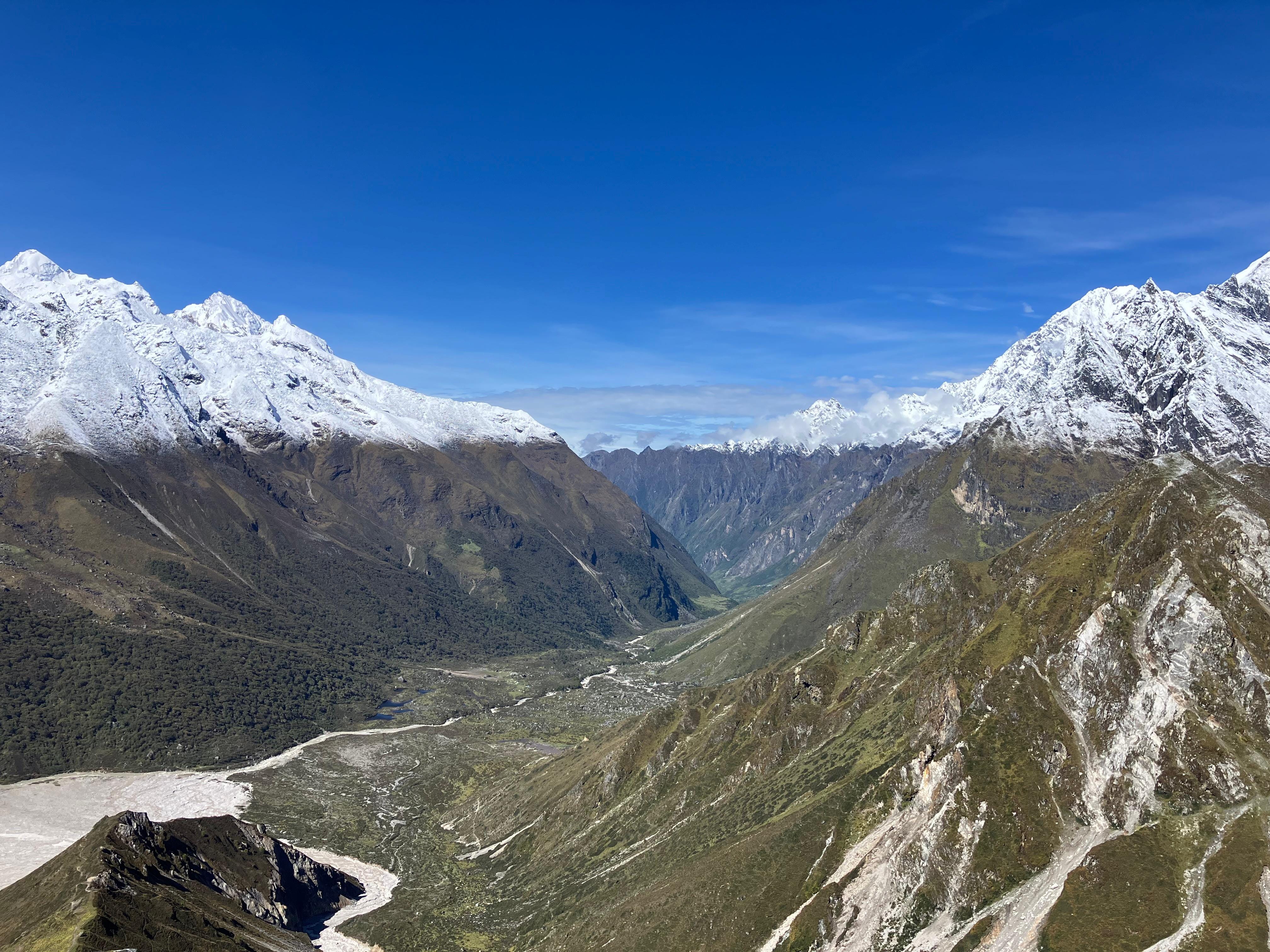
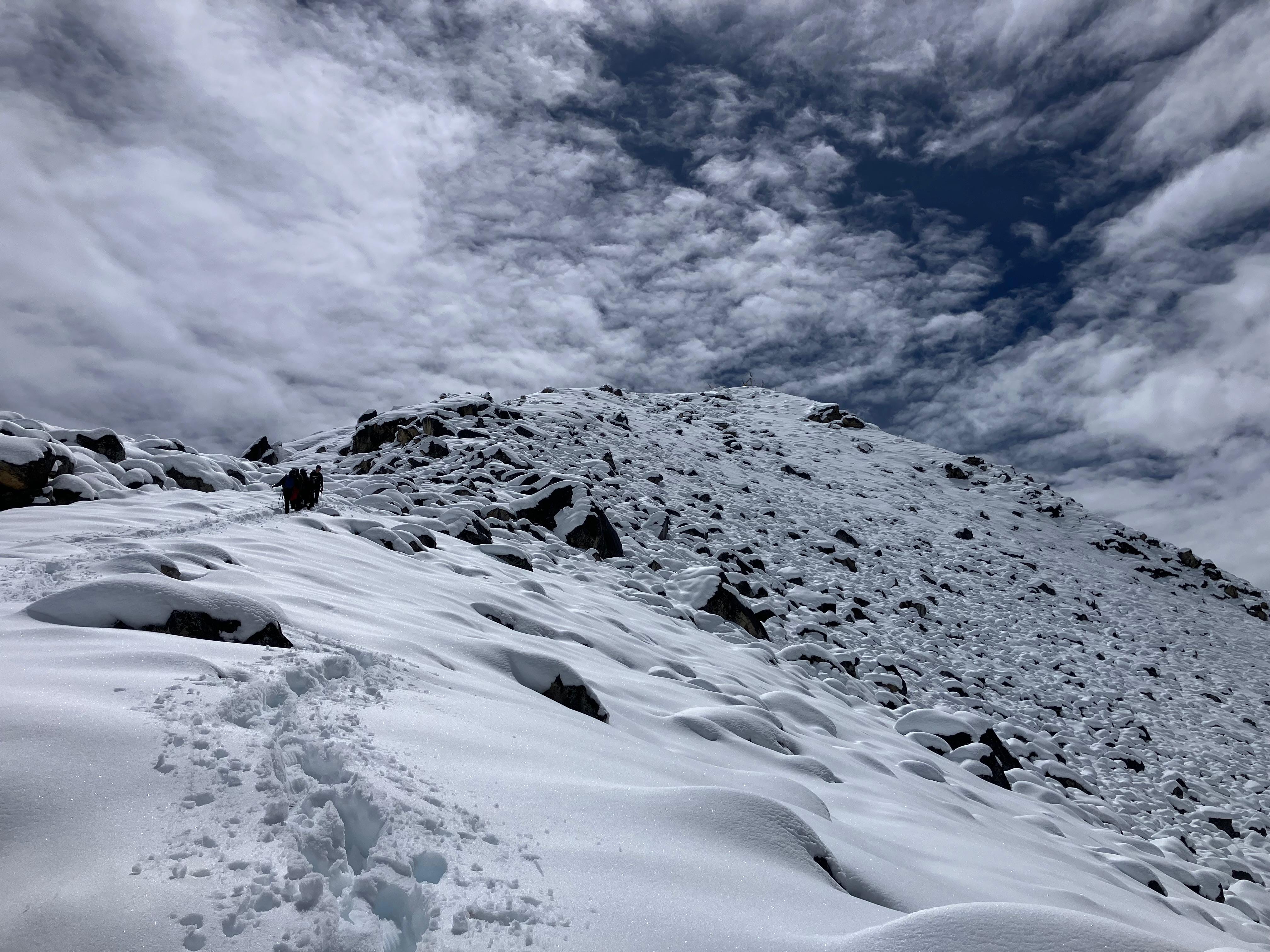
After 48 hours of continuous rain, we awoke to a beautiful clear morning, and the peaks that surround the valley were finally revealed, radiating with a blanket of fresh snow. Today was the day to climb Tserko Ri (4985m), a small peak that sits above the village. I left with my companions from the teahouse, but soon left them behind as we reached the snowline. After overtaking a few more groups, I started breaking the trail myself, which got slower and more taxing as I ascended. Near the top, I reached a huge boulder field, now covered in almost a metre of snow. A few German hikers caught up with me, and we took it in turns leading through the white maze. About 100 metres beneath the summit, we came to a stop, and after a quick discussion agreed that with the perilous gaps between the boulders completely obscured, the risk of injury was getting a little too high. As always, I'm happy to turn around when conditions dictate, so I retraced my steps as the sound of regular avalanches and rockfalls echoed from the next side valley.
The following couple of days had more clear weather forecast, so I decided to make the most of them by pushing back down the valley towards Syabrubesi, before taking a trail south up a steep climb to the lakes of Gosaikunda, and over the Lauribina Pass (4610m) . The trail had been washed away in a few places, but there was always an available detour through the undergrowth.
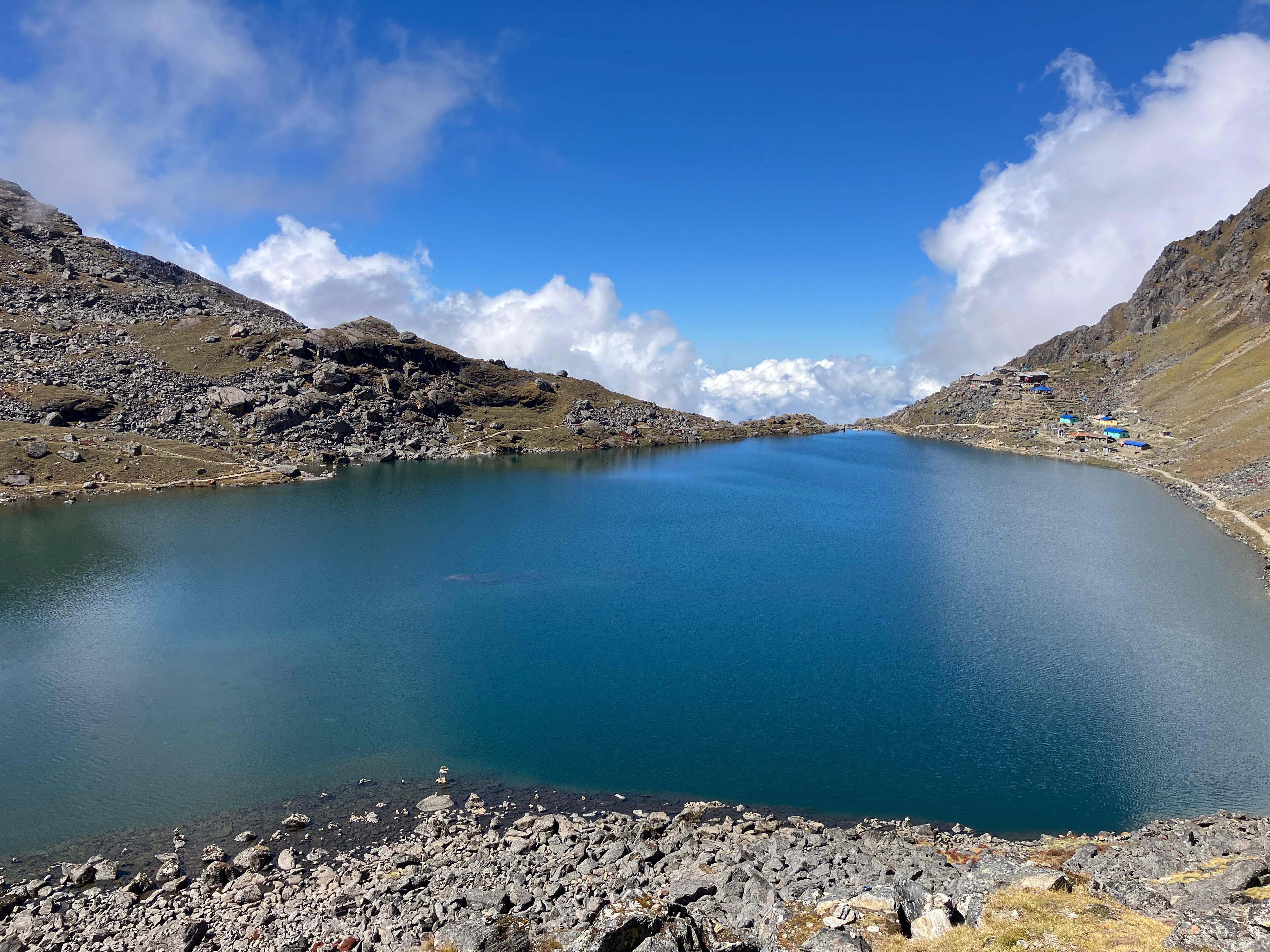
I really enjoyed the next few days of solitary hiking, as I left the high mountains of Langtang and entered the misty Nepalese foothills, other than for the fact that I'd badly sunburnt my legs on Tserko Ri, distracted as I was by trying not to break an ankle, and underestimating the sun glare from the snow. Excluding this mild discomfort, it felt great to be back amongst the terrace farms and small villages, and it reminded me of my hiking back in Himachal Pradesh this spring. From the heights of Lauribina, Kathmandu is a long downhill, first over the hills of Helambu, and then through the deep forests of the Shivapuri National Park which sits just to the north of the city. Just 10 days after leaving in an early morning jeep, I was back in the bustling metropolis, ready for a few days of rest before heading for one of my favourite places in the world: the Khumbu.
❤️
Great to read about your first weeks in Nepal. Have a wonderful time trekking with Kevin.🙂xx